Greetings
Hokkaido University has recently been selected for the AMED (Japan Agency for Medical Research and Development) “Program for Supporting Medical Research,” and has launched the project entitled “Strategic Promotion of Next-Generation AI-Enabled, Data-Driven, and Information-Circulating Medical Research through the Integrated Development of People, AI/DX, and Systems” (PRISM-HU).
In recent years, medical research in Japan has faced a serious challenge: the depletion of “true research time” due to the increasing workload placed on researchers. This issue is particularly pronounced in Hokkaido, where travel required to maintain regional healthcare places an additional burden on researchers.
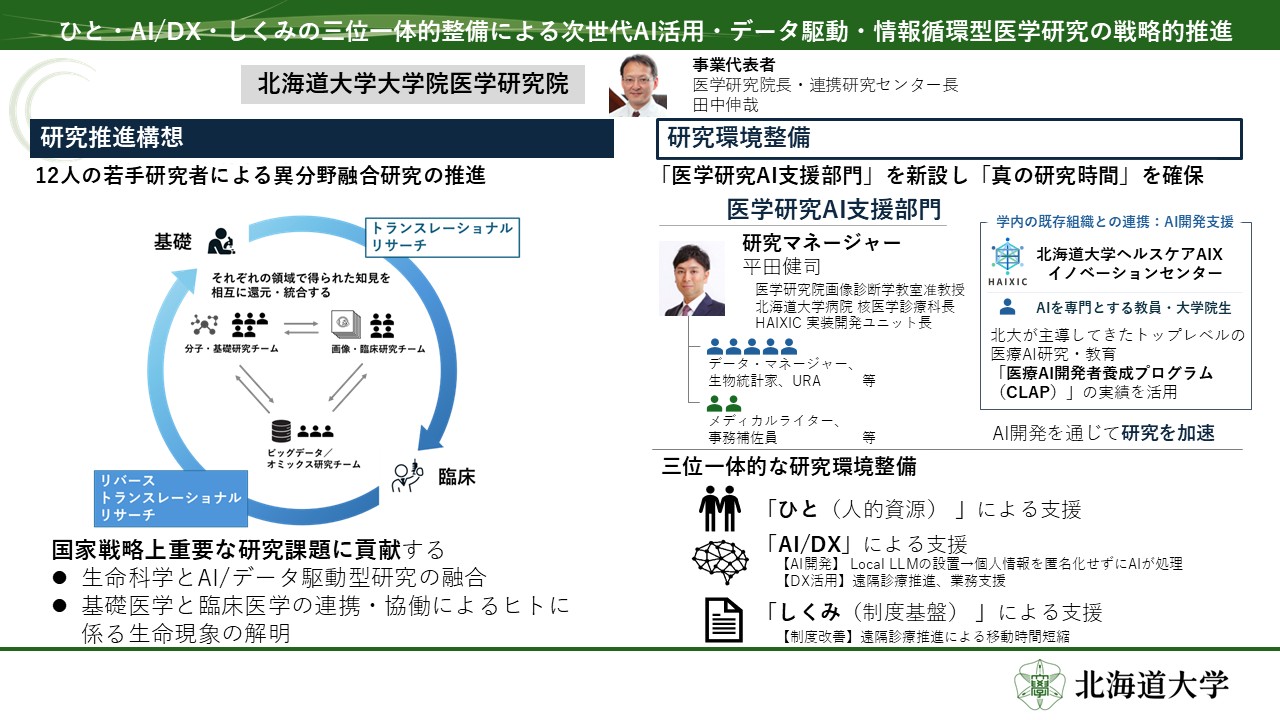
The PRISM-HU initiative represents a challenge to overcome this structural issue. We will develop, in an integrated manner, people (specialized human resources) to support research, AI/DX to improve operational efficiency and advance research quality, and systems (institutional frameworks) that enable researchers to devote themselves fully to their research work.
As a core organization, we have established a Division of AI Support for Medical Research, appointing Associate Professor Kenji Hirata—an expert in nuclear medicine and AI research and development—as Research Manager. Through this structure, we will provide strong support to highly motivated early-career researchers serving as principal investigators (PIs). By promoting information-circulating research that links basic science and clinical medicine, we aim to build a support system that can be utilized by all physicians at Hokkaido University Hospital.
We will continue to strive so that the “Hokkaido University Model” established through this project can contribute to revitalizing medical research throughout Japan. We sincerely ask for your continued support and cooperation.
TANAKA Shinya, M.D., Ph.D.
Dean
Faculty of Medicine and Graduate School of Medicine/
School of Medicine, Hokkaido University
Research Manager’s Greeting
— Reclaiming “True Research Time” —
My name is Kenji Hirata, and I serve as the Research Manager of the Division of AI Support for Medical Research. My professional background is in radiology and nuclear medicine, and while working in both clinical practice and medical research, I have also been actively involved in the application of AI—particularly data analysis and generative AI—in the medical field in recent years. In addition, I have also served as a coordinator faculty member for the Hokkaido University Clinical AI Human Resources Development Program (CLAP).
Through daily clinical duties, education, and increasing administrative work, I have personally felt the growing challenge that researchers face: the gradual loss of time to truly think and focus on research. Even the best ideas cannot be realized without sufficient time and appropriate support structures. PRISM-HU was established based on this shared experience from the field.
In this initiative, we are building an integrated support system based on three pillars: people, AI/DX, and institutional frameworks and systems. The Division of AI Support for Medical Research combines human expertise with a secure, on-site AI infrastructure, providing comprehensive support ranging from research planning and data analysis to various research-related tasks.
My role is to connect researchers, support staff, AI technologies, and institutional systems, and to ensure that a practical and sustainable framework for advancing research takes root in daily practice. By valuing dialogue that transcends disciplines and positions, I hope to foster a research support model that is uniquely suited to Hokkaido University.
Through PRISM-HU, I sincerely hope that each researcher will be able to reclaim “true research time,” enabling new medical knowledge to emerge from Hokkaido University and reach the world.
Kenji HIRATA
Associate Professor
Hokkaido University Graduate School of Medicine
Background
There is a growing concern regarding the decline of Japan’s international competitiveness in basic life sciences and medical research. A primary cause is the severe shortage of “True Research Time”—the time researchers need for creative thought and core research—as they are increasingly overwhelmed by clinical practice, education, and administrative duties.
In Hokkaido specifically, this issue is exacerbated by the region’s unique geography; university hospital physicians spend significant time traveling to provide regional medical support across vast areas, making it even more difficult to secure dedicated research time.
Objectives
This project aims to overcome these structural challenges and fundamentally strengthen the research environment. By integrating “People” (support staff), “AI/DX” (advanced technology), and “Systems” (institutional frameworks) as a “Trinity” of support, we will secure and create “True Research Time” for our researchers.
Building upon this reform, we will accelerate the “fusion of life sciences with AI/data-driven research” and the “collaboration between basic and clinical medicine”—areas where our university excels—to strategically promote next-generation, data-driven medical research through continuous information cycles.
Core Philosophy
We have named this initiative “PRISM-HU (Platform for Research Innovation and Support in Medicine – Hokkaido University)”. Under this philosophy, we will implement the following three elements in unison to reform the research environment and strategically advance research activities:
- People (Human Resource Infrastructure): We will deploy a diverse range of specialists—including Data Managers, Biostatisticians, AI Programmers, URAs, and Medical Writers—to provide end-to-end support, from research planning and data collection/analysis to manuscript drafting and dissemination.
- AI/DX (Utilization of Advanced Technology): By leveraging Generative AI, such as privacy-conscious Local Large Language Models (Local LLMs), we will automate and streamline tasks such as clinical summary generation, database entry, and surgical video editing, thereby liberating time for research.
- Systems (Institutional Framework): We will formally introduce “Dedicated Research Time” to allow researchers to focus on academic inquiries. Additionally, we will reduce external clinical work through PI personnel cost systems and minimize travel time by promoting telemedicine and DX, while establishing a “Science Café” to spark new ideas through interdisciplinary interaction.
Research Promotion Goals
This project will select 12 young PIs (Principal Investigators) who utilize AI and data-driven methods. They will be organized into the following three research teams to promote integrated, information-circulating research where basic medicine, clinical medicine, and information science collaborate:
Sub-theme 1:
The Molecular and Basic Research Team Elucidating the pathogenesis of intractable diseases by integrating spatial molecular data and expression profiles.
Sub-theme 2:
Imaging and Clinical Research Team Revolutionizing disease understanding and prognostic prediction through AI-driven objective quantification of human phenotypes, such as surgical videos, gait analysis, and fundus images.
Sub-theme 3:
The Big Data Omics Research Team Constructing high-precision models by integrating diverse Real-World Data (RWD), including electronic health records, genomics, and pathological images.
Through these efforts, we aim to continuously produce high-impact research contributing to Top 10% papers and establish a world-class research hub.
Ultimately, we intend to expand the research support frameworks established here (AI tools and support systems) as the “Hokkaido University Model”—first within the Faculty of Medicine and University Hospital, then university-wide, and eventually to universities and research institutions nationwide—to lead the reform of Japan’s research environment.
実施体制