
Tackling the Cancer Microenvironment: Hokkaido University and the University of Melbourne to Hold Joint Research Workshop in Sapporo in August
The Faculty of Medicine at Hokkaido University, in collaboration with the University of Melbourne in Australia, will hold a joint cancer research workshop entitled “Cancer microenvironment and next generation research collaboration” at Hokkaido University from 19 to 21 August 2026.
The workshop is one of the projects selected for funding in fiscal year 2026 under the Hokkaido University–University of Melbourne Joint Research Workshop Fund. Taking cancer research as its starting point, the workshop aims to generate new international collaborative research in medicine and the biomedical sciences and develop it into sustained research and educational collaboration between the two universities.
About the Workshop
The Hokkaido University team will be led by Professor Shinya Tanaka, Dean of the Faculty of Medicine. The University of Melbourne team will be led by Professor Frederic Hollande, Deputy Head of the Melbourne Medical School and Head of the Department of Clinical Pathology.
The two universities have complementary expertise in cancer biology and related fields. Researchers at the University of Melbourne specialise in areas including the tumour microenvironment, cellular barcoding, spatial transcriptomics and tissue engineering. Hokkaido University, meanwhile, has strengths in a broad range of fields, including cancer stem cell biology, tumour heterogeneity, AI-assisted diagnostic imaging, natural language processing, genomic analysis, robotic surgery, hydrogels and nanomaterials.
By bringing together this expertise, the workshop will facilitate the development of collaborative research themes that transcend disciplinary boundaries across basic medicine, clinical medicine, information science and engineering.
The workshop is planned as a hybrid event combining in-person and online participation. A large number of Hokkaido University participants are expected to attend, including researchers affiliated with PRISM-HU, early-career researchers and graduate students. During the workshop, participants will also explore collaboration in both research and education, including the development of jointly supervised PhD projects, student and researcher exchanges, and the possibility of reciprocal clinical placements for medical students.
Expanding Collaboration with the University of Melbourne
Hokkaido University and the University of Melbourne have developed research collaboration over many years in fields including zoonotic infectious diseases and chemistry. To further advance this relationship, the two universities agreed to explore new research partnerships, promote interdisciplinary research and expand the joint supervision of PhD students. To support these goals, they established the Hokkaido University–University of Melbourne Joint Research Workshop Fund.
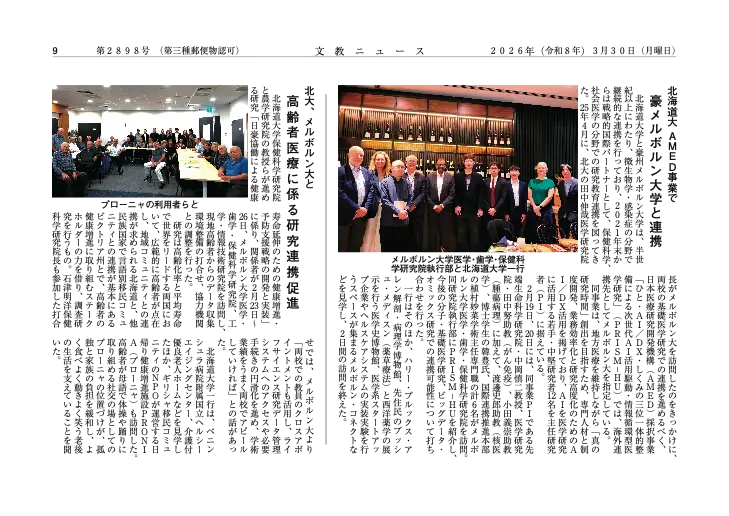
On 19 and 20 February 2026, a delegation of PRISM-HU researchers visited the Faculty of Medicine, Dentistry and Health Sciences at the University of Melbourne. During the visit, the delegation introduced PRISM-HU’s initiatives to the Faculty’s executive leadership and exchanged views on opportunities for future collaboration in areas including basic medicine, big data and omics research. The delegation also visited the Medical History Museum and Melbourne Connect, an innovation precinct that brings together start-ups in fields including medicine and pharmacy.
The visit was featured in Issue No. 2898 of Bunkyo News, dated 30 March 2026, under the headline “Hokkaido University Collaborates with the University of Melbourne through an AMED Project.” The article reported that PRISM-HU regards the University of Melbourne as an international partner, that the two universities are advancing collaboration in basic medical research, and that the researchers participating in the visit discussed prospects for future joint research.
The upcoming workshop will provide a new opportunity to develop these university-level exchanges into concrete collaborative projects in cancer research. Research themes emerging from the workshop will be pursued with the aim of generating sustained outcomes, including joint research projects, co-authored publications, joint applications for research funding and the development of early-career researchers.